Evolution of the Orthogonal Frequency Division Multiple Access (OFDMA).
Every new Wi-Fi technology until the Wi-Fi 6 has focused on increasing the bandwidth and speed in general. Except for increasing speed and data rates, the Wi-Fi 6 (802.11ax) has mainly focused on efficiency, therefore the high efficiency (HE) term. It focuses on how to better share the channels in the existing Wi-Fi limited spectrum (2.4 GHz, and 5 GHz) and in the brand new 1200 MHz spectrum that the FCC made available in the 6GHz band starting with Wi-Fi 6E. In a nutshell, 802.11ac (Wi-Fi 5) was mostly optimized for a single client higher throughput. On the other hand, the 802.11ax is focused on improving efficiency and capacity of the entire network especially in high client density environments where many STAs compete for airtime to improve throughputs for all the clients. Wi-Fi 6 accomplishes this through many new technology innovations such as Multi-User Multiple-Input Multiple-Output (MU-MIMO), 1024 Quadrature Amplitude Modulation (1024-QAM), Basic Service Set (BSS) Coloring, and Orthogonal Frequency-Division Multiple Access (OFDMA).
Before we reached OFDMA in Wi-Fi 6, we were utilizing its predecessor Orthogonal Frequency Division Multiplexing (OFDM). With 802.11a/g OFDM the high data rate transmission was split into multiple smaller signals and with 20 MHz wide channel it is divided into 64 subcarriers or tones. There are 52 active subcarriers to transmit data using modulation and coding schemes (MCSs). Four of the subcarriers across the channel act as a pilot that helps with synchronization between receiver and transmitter. One of the eight unused tones in the center (DC) and seven of tones on the sides of the channel are used for better isolation from neighboring channels. In 20MHz wide channel each tone is 312.5 kHz because of the 20 MHz / 64 tones. With a OFDM downlink or uplink the entire 20 MHz channel is used for communication between AP and single STA.
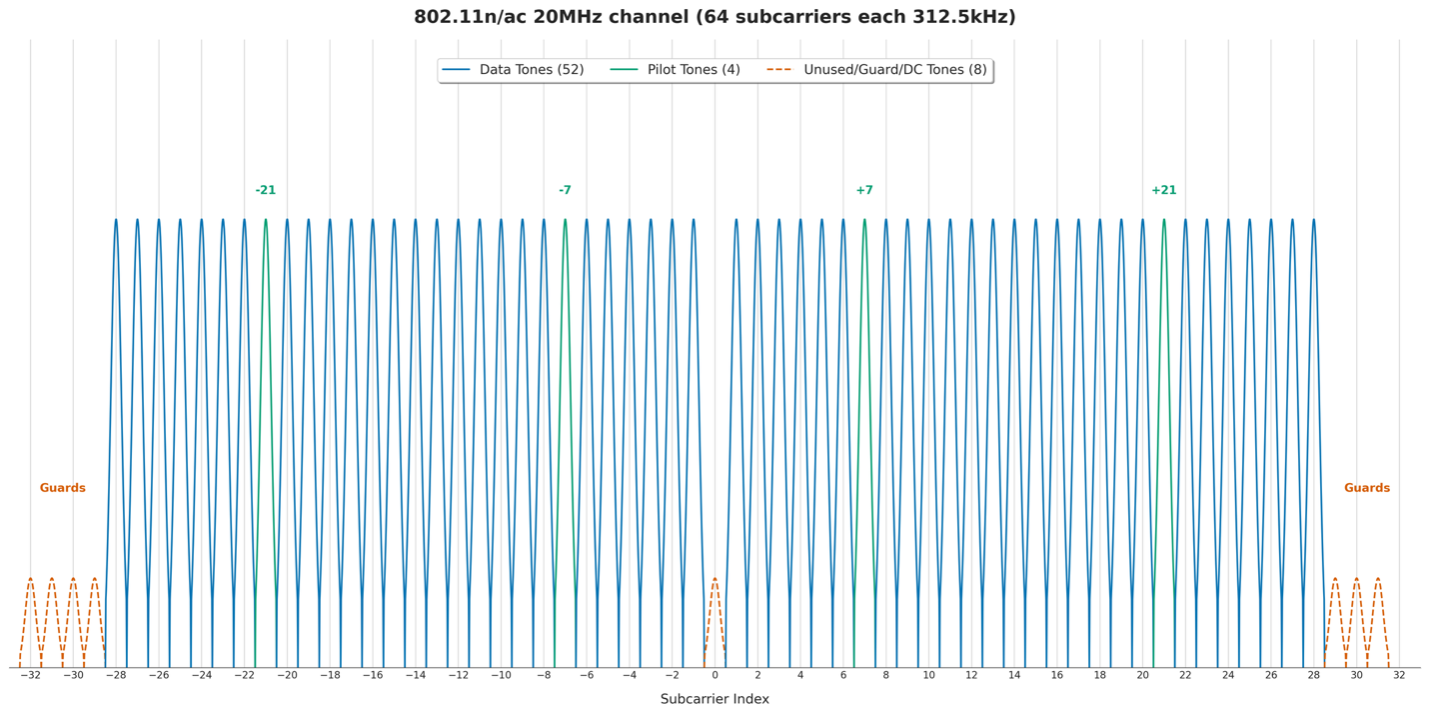
As the OFDM technology has progressed in 802.1n and 802.1ac amendments the better efficiency has been accomplished because the channel width has increased by bonding multiple channels together. Consequently, this utilizes more tones for data transfer because it creates a wider channel and utilizes more those tones instead of just using them for channel separation. In addition, the ability of the transceiver to demodulate each tone depends on the number of tones used, transmit power, coding rate, and constellation size.
In OFDMA narrower and denser tones per channel allow more efficient data throughput in multiuser environments thanks to innovations in the new 802.11ax chipsets. In the 802.11ax there is 256 tones each 78.125 kHz.
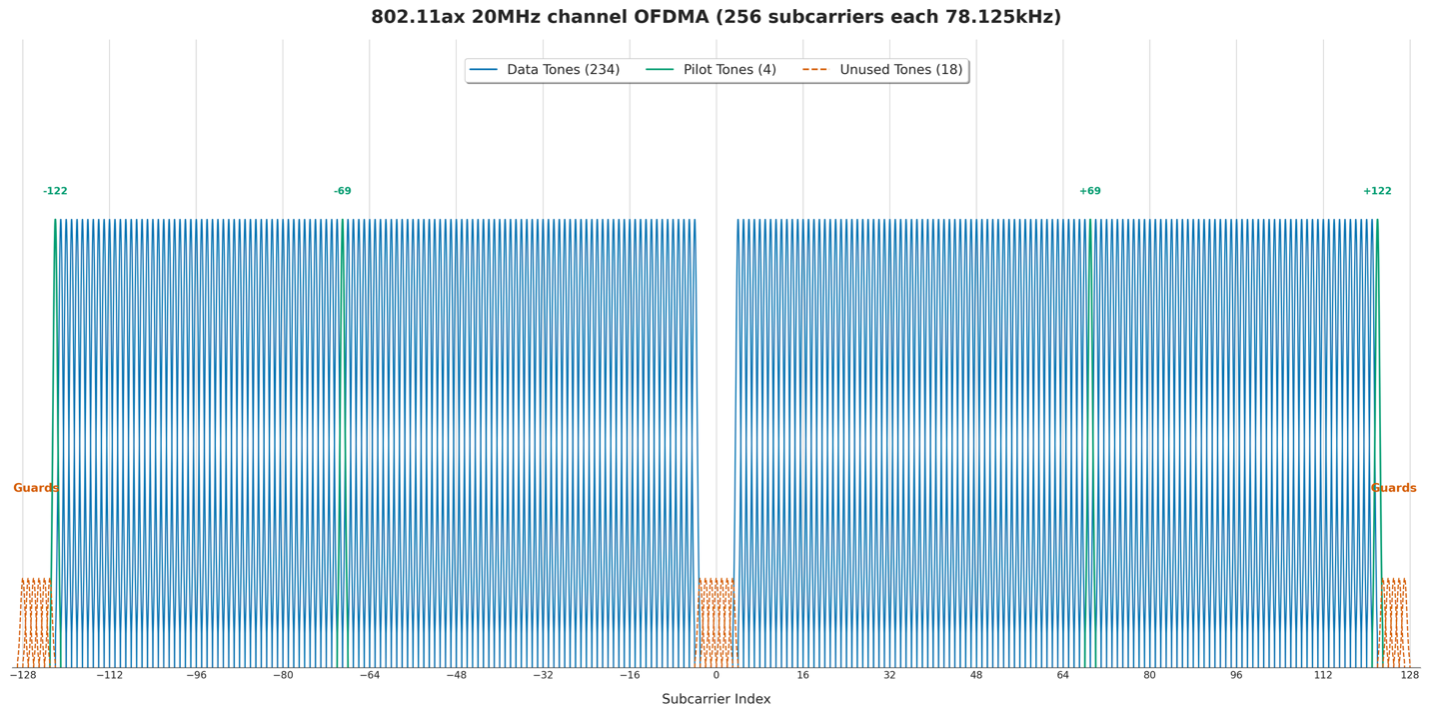
The OFDMA introduces the Resource Unit (RU) that is used in the multiuser transmissions where AP aggregates together available tones in one RU group and allocates this group to a device (STA) for its transmissions. The RU can be comprised of 26, 52, 106, 242, 484, or 996 adjacent subcarriers where the size of it depends on the channel width. This OFDMA can be used both in downlink and uplink in simultaneous transmission to multiple users in parallel. In the uplink, the AP knows the bandwidth needs of each STA and allocates one RU per each STA best suited for the BSS overall throughput. Consequently, the next UL-MU-MIMO TXOP transmission is sent to multiple STAs simultaneously. The only drawback is that if the RU is only partly utilized then the rest is filled with padding which could be wasteful in overall. While the OFDMA significantly improves spectrum utilization by allowing multiple users to transit or receive simultaneously in different groups of subcarriers, the single-RU results in inefficient spectrum utilization.
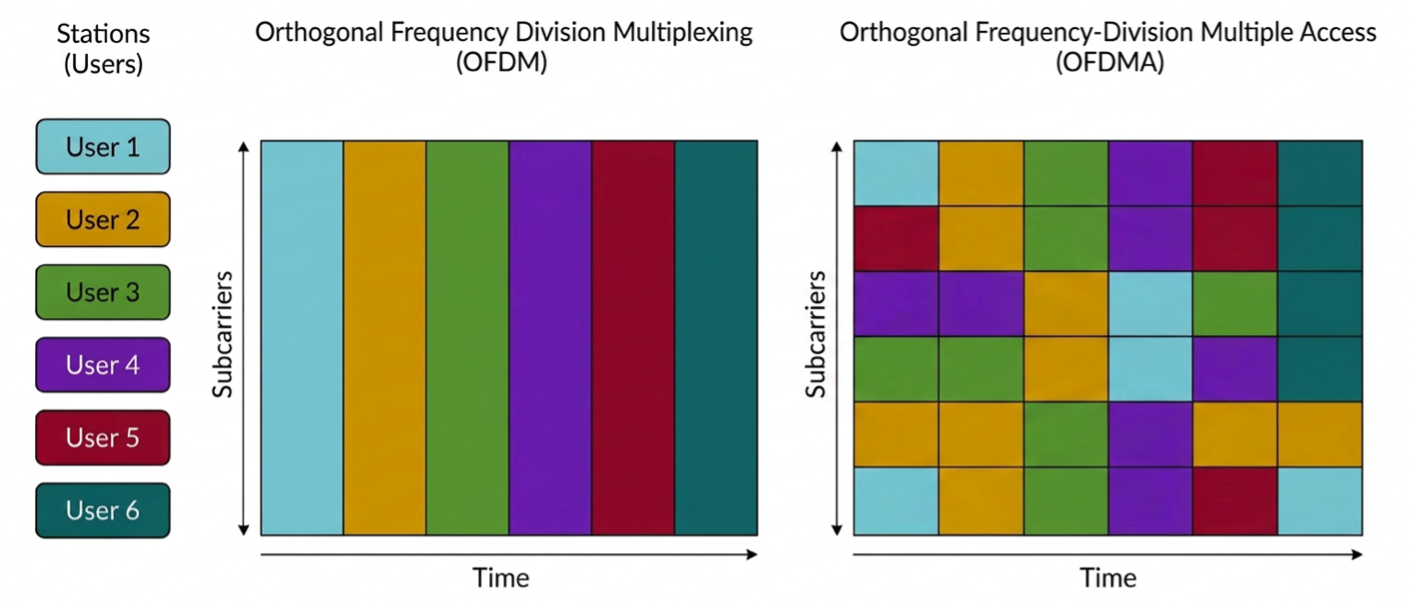
That is where the next OFDMA evolution comes in with Wi-Fi 7 (802.11be) in the form of Multiple Resource Unit (M-RU). This allows a single station to allocate multiple contiguous or noncontiguous RUs in the same transmission in the same channel to maximize the spectral efficiency. Improving flexibility and throughput. Wi-Fi 7 continues to support RU but it adds ability to combine multiple RUs into large logical blocks. Instead of allocating a STA, one large RU can allocate multiple small RUs in different parts of the channel and process them as unified transmission. This is how the fragmented spectrum gets better utilized which reduces unused bandwidth which would be wasted otherwise. This is particularly beneficial in the very high-density environments such as stadiums, public venues, campuses, and class lectures where there is a simultaneous air-time competition between devices. As a result, network schedulers can dynamically allocate resources better based on stations bandwidth needs instead of wasting the single RU size per STA if it doesn't need it. This is very useful in a situation like IoT devices versus AR/VR/4K/8K video streaming. The Wi-Fi 7 scheduler can dynamically allocate small size M-RUs requiring low bandwidth compared to large size M-RUs requiring high bandwidth with low delay/latency for a time sensitive data transfer.
Consequently, in Wi-Fi 7 M-RU OFDMA with Multi-Link Operations (MLO) and enhanced scheduling mechanisms achieve higher throughput and lower latency than the previous generations by utilizing multiple portions of the channel simultaneously while minimizing wasted spectrum. Support for greater number of devices with more efficiency and increasing demand from applications. Also, one of the most practical and useful applications enabled by the M-RU is "preamble puncturing". If a device, such as radar or some local source of noise interferes with a specific 20 MHz part of the bonded channel like in 80 MHz, 160 MHz or even the latest 320 MHz a Wi-Fi 7 Access Point (AP) doesn't have to completely abandon the entire bonded channel. It can just reduce or "puncture" the part of the channel that is affected by the interference and aggregate and utilize the rest of the channel spectrum that is not affected by it. Therefore, M-RU works around only in the clean spectrum, and it can reduce the interference by this intelligent spectrum utilization mechanism that can increase the effective data bandwidth in real-time RF conditions.
Resources:

Comments: